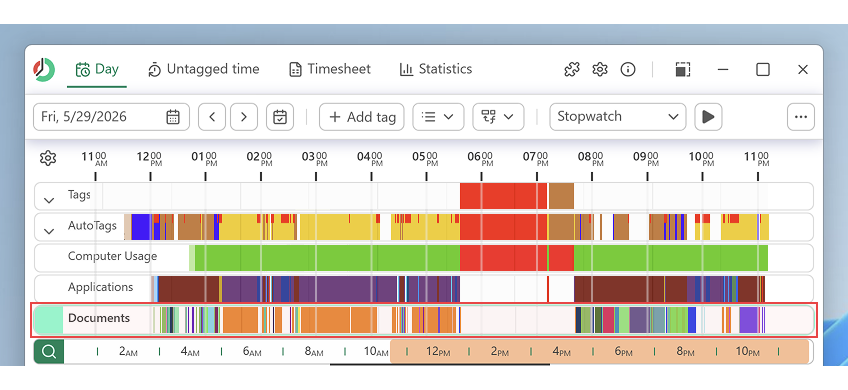
Document timeline
ManicTime will try to extract additional data from the following applications and display it in the Documents timeline:
- Internet Explorer - current URL
- Firefox - current URL
- Google chrome - current URL
- Opera - current URL
- Microsoft Word - currently opened file
- Microsoft Excel - currently opened file
- Microsoft PowerPoint - currently opened file
- Adobe Photoshop - currently opened file
- Microsoft Visual Studio - currently opened file, project and solution
- Microsoft OneNote - currently opened page
- Microsoft Outlook (new) - currently opened email (reading or writing)
- Adobe Illustrator and Adobe InDesign - currently opened document
- Affinity 3, Designer 2, Photo 2, and Publisher 2 - currently opened document
- Rhino, Matrix, Master PDF Editor, and MeasureSquare - document name extracted from the window title
- AutoCAD - currently opened drawing
- File Explorer - current folder or file path
- WhatsApp - current chat title
- ............
These are specific plugins written for each of the mentioned applications. We constantly add new plugins, so check which apps are supported in Plugin manager.
For supported browsers, ManicTime can record the current URL in the Documents timeline. Firefox-based Zen, Waterfox, LibreWolf, and Floorp need the ManicTime Firefox extension. Chromium-based browsers use the corresponding browser extension where required. If ManicTime records the browser application but not the URL, check that the extension is installed and enabled.
Obsidian, JetBrains IDEs, and Photoshop can provide document details through their own ManicTime plugins. Install those plugins from the application's plugin store when you need more detail than its window title provides.
General plugin
A lot of applications post data about open files and other information in the application title. Let's take Notepad as an example. If you open a document in Notepad, the window title of the application will show up as:
'Some document - Notepad'
The name of the document is included in the title of the application, in this case it is 'Some document'. If we wanted to extract document name and use it on document timeline, we would have to extract the first part of the title.
So what we need to do is, whenever ManicTime detects Notepad, apply some filter which extracts document name from the title.
ManicTime has a plugin which does just that. To use this plugin you need to have some understanding of regular expressions. In this case you can do something like this:
Notepad (.\*?)-\[^-\]\*$
The first part of the rule is the name of the executable, so if notepad's executable is notepad.exe, you just write notepad.
These rules are set in [ManicTime INSTALL folder]\Plugins\Packages\ManicTime.DocumentTracker.CustomTitle\Lib\CustomTitle.txt
You can change the rules there, but we recommend that you add your rules to
[ManicTime DATABASE folder]\Plugins\Storage\ManicTime.DocumentTracker.CustomTitle\Content\CustomTitle.txt
If you change it in the installation folder, it will get overwritten next time you upgrade ManicTime. Rules in
[ManicTime database folder]\Plugins\Storage\ManicTime.DocumentTracker.CustomTitle\Content\CustomTitle.txt
will have higher priority than those in install folder and they will not get overwritten with new updates.
When you change the rules, restart ManicTime for the rules to take effect.
These rules will only work on the data collected from now on. They will not work on historical data (you can use Autotags if you would like something similar for historical data).
Outlook plugins
ManicTime 2026.2.2 and later include the Microsoft Outlook (new) document tracker in the Windows installer. It records the subject of the email you are reading or composing in the Documents timeline. For a message you are reading, it can also include the sender. Look for Document timeline: Microsoft Outlook (new) in Plugin Manager.
The separate plugin for classic Microsoft Outlook is not part of the default installation because Outlook can show connection warnings on some computers. If you use classic Outlook, install Document timeline: Microsoft Outlook through Plugin Manager. It can record the email you are reading or writing.